
Every plastics factory produces some waste: trimmed edges, start-up purge, rejected parts, runners. When that material is clean and compatible, recovering it can keep useful polymer in circulation and cut the volume sent away for disposal. Whether the effort pays off, however, depends far more on the scrap than on the machine.
Know your scrap before you shop
A supplier can only recommend a line if they know what will enter it. Prepare a short profile for each scrap stream, covering:
- Polymer type and grade
- Source, such as in-house trim, rejects or post-use material
- Form: film, rigid pieces, lumps or runners
- Typical quantity per batch or per day
- Contamination risks: labels, dirt, moisture, metal or other polymers
- Whether drying or washing is needed
Describe separate streams separately. Treating clean production trim and dirty returns as one feedstock leads to unrealistic expectations of output and cost.
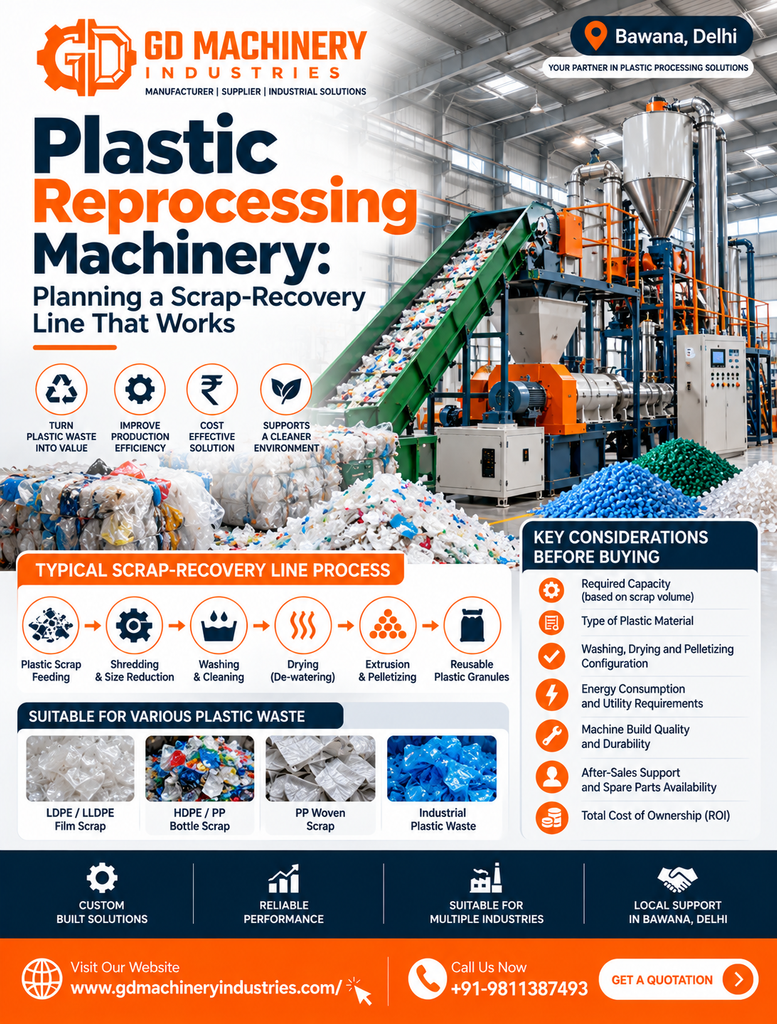
The stages of a typical line
| Stage | What it does | Question to ask the supplier |
|---|---|---|
| Sorting | Separates polymers and removes foreign matter | How are mixed polymers kept apart? |
| Size reduction | Cuts scrap into uniform pieces | Which forms, film or rigid, can the unit take? |
| Washing and drying | Removes dirt and moisture where needed | Is this stage inside the quoted scope? |
| Feeding | Delivers material steadily to the extruder | How does it cope with light film or irregular pieces? |
| Melting and filtration | Melts the polymer and removes impurities | How and how often is the screen changed? |
| Pelletising | Turns recovered melt into granules | What output form and cooling arrangement apply? |
Some machines combine several stages while others need separate auxiliary units, so confirm exactly what each proposal covers.
Where the economics can go wrong
On paper, recovery looks simple: scrap in, granules out. In practice the result depends on the value of the recovered polymer, energy use, labour, maintenance, filters, wear parts and processing losses. Mixed or contaminated scrap raises sorting and preparation costs, and unusable residue still has to be handled. Build your estimate from the scrap you really generate, not from a nameplate capacity.
Will the recovered material be accepted?
Recovered polymer is not suitable for every product. Agree with the production team which properties the material must meet, keep recovered batches identifiable and test quality instead of assuming it. Regulatory or customer requirements may restrict its use in certain products.
Choosing and testing the equipment
Look at screw and barrel suitability, steadiness of feeding, filtration, the form of the output, how screens are changed, cooling and operator safety. Ask which parts wear and how quickly. If your feedstock varies from batch to batch, say so early. A trial with representative scrap can expose feeding trouble, unstable processing or poor output quality that no brochure will reveal.
Setting up the working area
Leave room for incoming scrap, sorted material, machine access and finished regrind or pellets. Check electrical supply and ventilation, plan safe movement of material and label polymers clearly so incompatible grades never meet.
Keep a running record of what goes in, what comes out in usable form, rejects, stoppages and power use. Those numbers reveal whether the line delivers on its technical and financial aims.
Final Thoughts
Think of plastic reprocessing as managing a material flow, not simply buying a machine. The cleanliness of your scrap, the layout of the line, safety, upkeep and the standard the recovered polymer must meet all count. A clear description of your scrap and your expected output allows a supplier to judge equipment suitability far more accurately.
Frequently Asked Questions (FAQs)
1: Which plastics are suitable for recovery?
A: That depends on the polymer and the machine, so name the exact grade and ask the supplier to confirm it can be processed.
2: Do all recovery lines wash the scrap?
A: No. Washing, drying, shredding and pelletising can be separate steps, and clean in-house scrap may skip some of them.
3: Can reclaimed polymer replace virgin material in any product?
A: Not in every case. It depends on its quality, how it was processed and what the final product requires.
4: What decides whether recovery is cost-effective?
A: Scrap cleanliness, energy, labour, upkeep, filters, yield and the resale or reuse value of the output.
Q: How does a trial help?
A: It shows how your actual scrap feeds, melts and comes out, which is hard to judge from specifications alone.