
Extrusion lamination bonds a substrate to a thin film of molten polymer, giving packaging and industrial-fabric makers added surface protection, sealing ability or a barrier layer in a single pass. The technique is flexible, but a plant that performs well on one structure may struggle on another. This guide walks through the process, the materials involved and the points worth settling before you place an order.
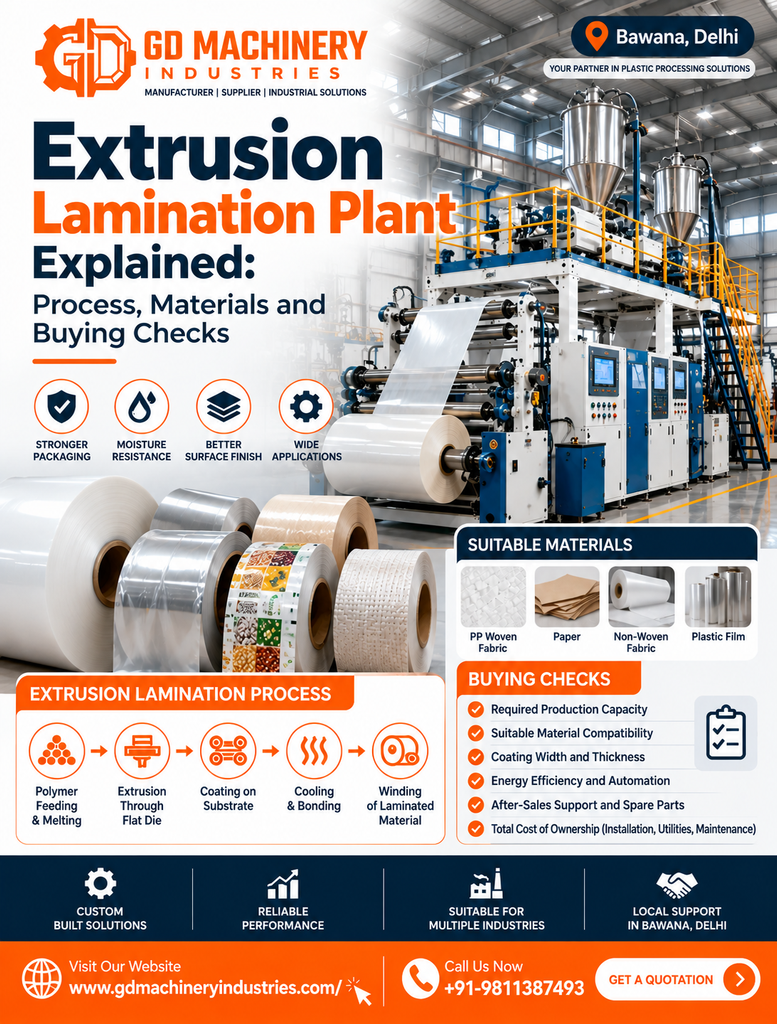
The process, step by step
- Polymer granules enter the extruder, where heat and screw action melt them.
- The melt is pushed through a flat die and leaves it as a thin, wide curtain.
- The curtain meets a moving substrate at a roller nip, where pressure helps the layers bond.
- The laminate is cooled so the polymer layer sets.
- The finished roll is wound, or passes on to another stage such as a second coating or slitting.
Line layouts differ with the application. Polymer grade, coating weight, substrate preparation, line speed and temperature control all shape the result.
Why a rated speed is not a promise
Maximum line speed is measured under one particular set of conditions. Change the substrate, thicken the coat or tighten the quality target, and the practical speed can fall. When a figure is quoted, ask: at which material, coating weight and quality level is this achievable?
Materials and typical uses
Depending on plant design, extrusion lamination is used with woven PP or HDPE fabric, paper, non-woven material, flexible packaging webs, tarpaulin fabric and the fabric used for jumbo (FIBC) bags. No single configuration handles all of these equally well, so confirm compatibility for your exact substrate.
End use matters as well. A structure meant for dry industrial goods faces different demands from one that protects moisture-sensitive contents, and food-contact or chemical applications may call for extra material and compliance checks.
Components worth reviewing
- Extruder and feeding system
- Flat die and its adjustment arrangement
- Unwind stand and web guiding
- Laminating roller arrangement
- Cooling section
- Winding unit
- Electrical and control panel
For each item, ask whether it is standard or optional, and confirm the working width, substrate range, polymer compatibility, coating-weight range and winding arrangement. Also inspect guarding, emergency stops, maintenance access and spare-part availability, since these shape safe operation long after installation.
Run a trial that proves something
Decide the pass criteria before the trial, not after it. Define the substrate, polymer and target coating weight, then choose checks that matter for the finished laminate, such as coating appearance, bonding, web stability and roll formation. Record the settings and any limits observed.
A single successful sample will not guarantee every condition, yet it tells you much more than a brochure does, and the logged settings give commissioning a head start.
Plan quality routines early
Operators should know which settings are critical, how changes are logged and what to do when output drifts from specification. Tell the supplier if the laminate goes on to printing, conversion or bag making, since those steps place their own demands on surface finish and roll build.
What a good quotation shows
- The machine configuration and every included accessory
- Delivery scope and who handles installation
- Operator training and documentation
- Warranty terms and any exclusions
When proposals are written on the same basis, their differences become easy to see.
Bottom Line
Select an extrusion lamination plant around the product it must create and the materials that go into it. Careful attention to process requirements, controls, safety, maintenance and running cost helps packaging manufacturers invest with confidence. GD Machinery Industries can use verified plant specifications to start the conversation, and buyers can help by sharing their substrate and production requirements up front.
Frequently Asked Questions (FAQs)
1: What does an extrusion lamination plant do?
A: It joins a base material to a melted polymer coating, which suits certain packaging and industrial-fabric products.
2: Which base materials are commonly used?
A: Woven fabrics, paper and non-woven sheets are typical, along with some flexible packaging films, provided the machine is built for them.
3: Is the top line speed what I will get every day?
A: Usually not. The speed you can sustain varies with the substrate, coat thickness, settings and quality target.
3: What information does a supplier need to quote?
A: Give the base material, roll width, polymer, desired coat weight, hourly output and what the laminate will be used for.
4: Is it worth asking for a test run?
A: Yes, when it can be arranged. Running your own material gives a realistic picture of results and limits.