
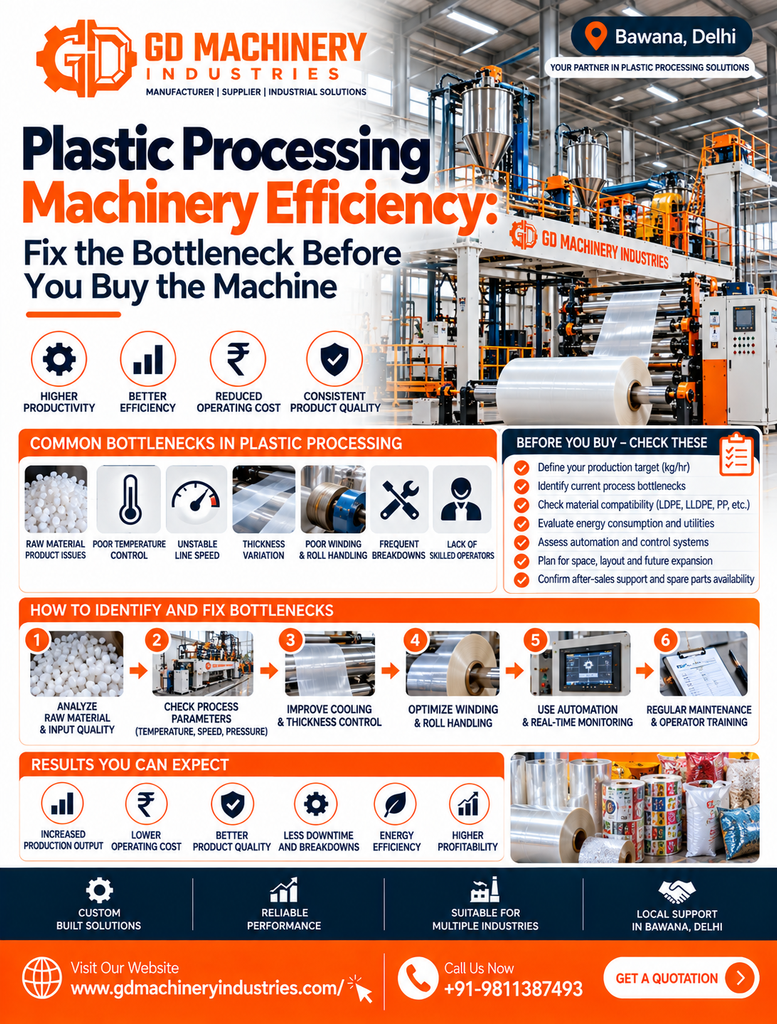
When output disappoints, the instinctive answer is a faster machine. Sometimes that is right. Often it is not, because usable output depends on the whole chain: material quality, equipment, people, maintenance and quality control. The sensible order is to diagnose first and spend second.
Build a baseline
Record output, downtime, rejects and energy use over a representative period, and note the product mix and operating conditions. Without that starting point, you cannot tell a real improvement from a lucky week.
Find the true bottleneck
Chart the path from material preparation to finished goods and estimate what each stage can really deliver once loading, changeovers, inspections and regular stops are counted. The slowest stage is not always the one that looks slow. Speeding up an early stage only builds a queue of half-finished goods when the following stage cannot absorb them.
Use production records to see where waiting time and rejected material accumulate. Then compare the options: a process change, better maintenance, tidier material handling or a new machine.
Size capacity to real demand
An undersized machine becomes a bottleneck, while an oversized line adds capital and utility cost you may never recover. Consider product mix, operating hours, changeovers and realistic growth. When suppliers give an output estimate, ask what material and quality target it assumes.
Tidy up material preparation
Moisture, contamination, blend consistency and particle size can all influence processing. Keep materials labelled and separated where compatibility matters, so mix-ups do not happen and quality problems can be traced to a batch. Add a mixer, dryer or reprocessing system only when its function matches a real material need.
Maintain before it breaks
- Stick to the maker’s schedule for inspections, greasing, cleaning, replacing worn parts and safety tests.
- Log faults, downtime and maintenance work so repeating patterns become visible.
- Know how quickly spare parts can be obtained and how long a service takes.
- Teach operators to speak up quickly about strange sounds, vibration, heat or shifts in the process.
Test changes properly
If you trial a new setting or modification, alter only one important variable per test where you can, and write down what happens. Compare like with like, using the same definitions each time. Before commissioning new equipment, decide how success will be measured afterwards so the investment can be judged on evidence.
Final Thoughts
The biggest efficiency gains come from tackling a problem you have actually measured. Fit equipment to material and demand, handle materials the same way every time, service machines before they fail and study data that means something. Before committing money to new plastic-processing equipment, identify the constraint and ask exactly how the machine will relieve it.
Frequently Asked Questions (FAQs)
1: Where should an efficiency project begin?
A: By measuring the biggest loss, whether that is stoppages, scrap, uneven output or slow material movement.
2: Will buying a quicker machine raise output?
A: Not necessarily, because quality, changeovers, stoppages, material and the next process step all limit the result.
3: How does material preparation influence results?
A: Moisture, dirt or uneven blends can make processing unstable and affect the finished goods.
4: Which numbers should I track?
A: Start with good output, rejects, downtime, power consumption and changeover time.
5: At what point does replacing a machine make sense?
A: When measured requirements cannot be met dependably and a replacement offers a clear, justified gain.